Tell Me About It: AOUA Rhei
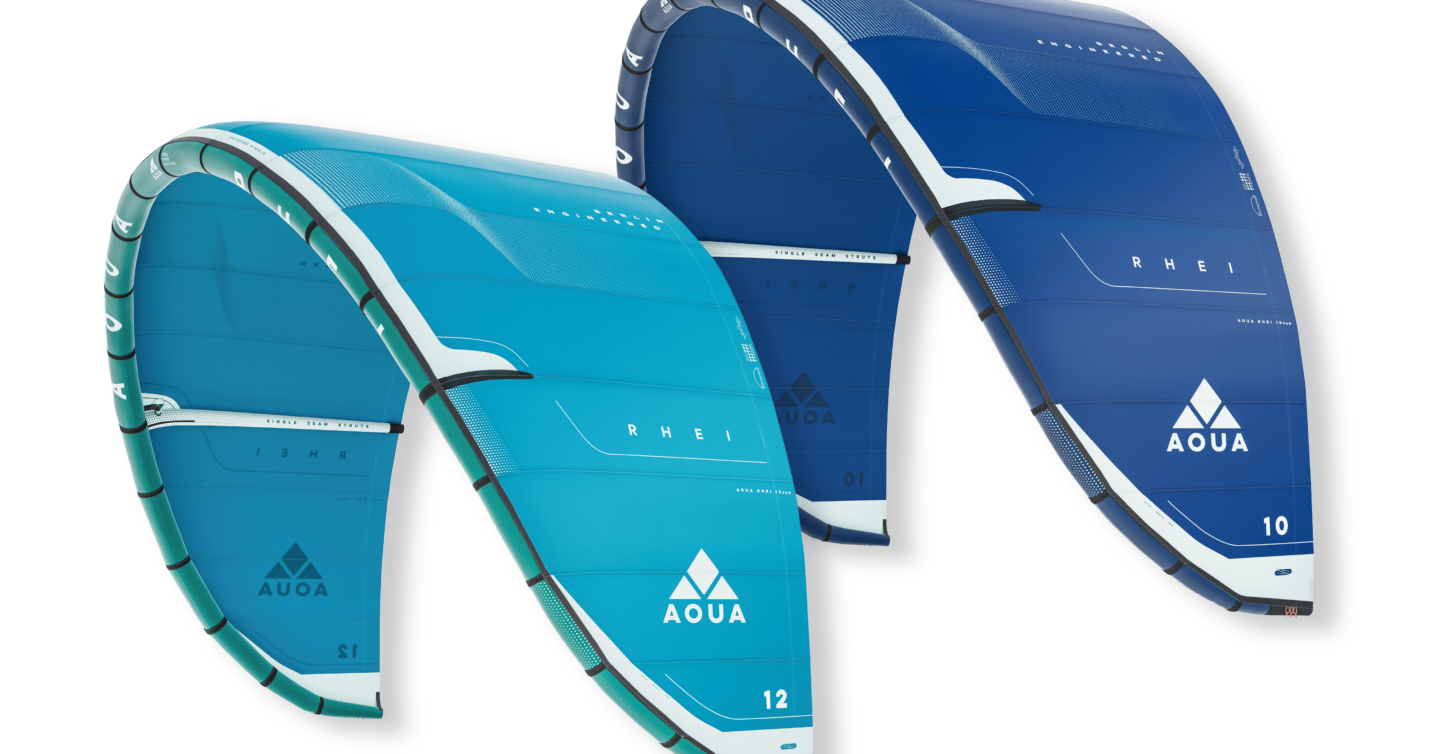
AOUA Kiteboarding have added a brand-new three-strut kite, the Rhei, to their range. Head of Product Development, Jan Alexander Rudolph gives us an overview.
THEKITEMAG ISSUE #67
When you purchase gear through links on our site, we may earn a small commission. Here’s why you can trust our tests and our affiliate partner.
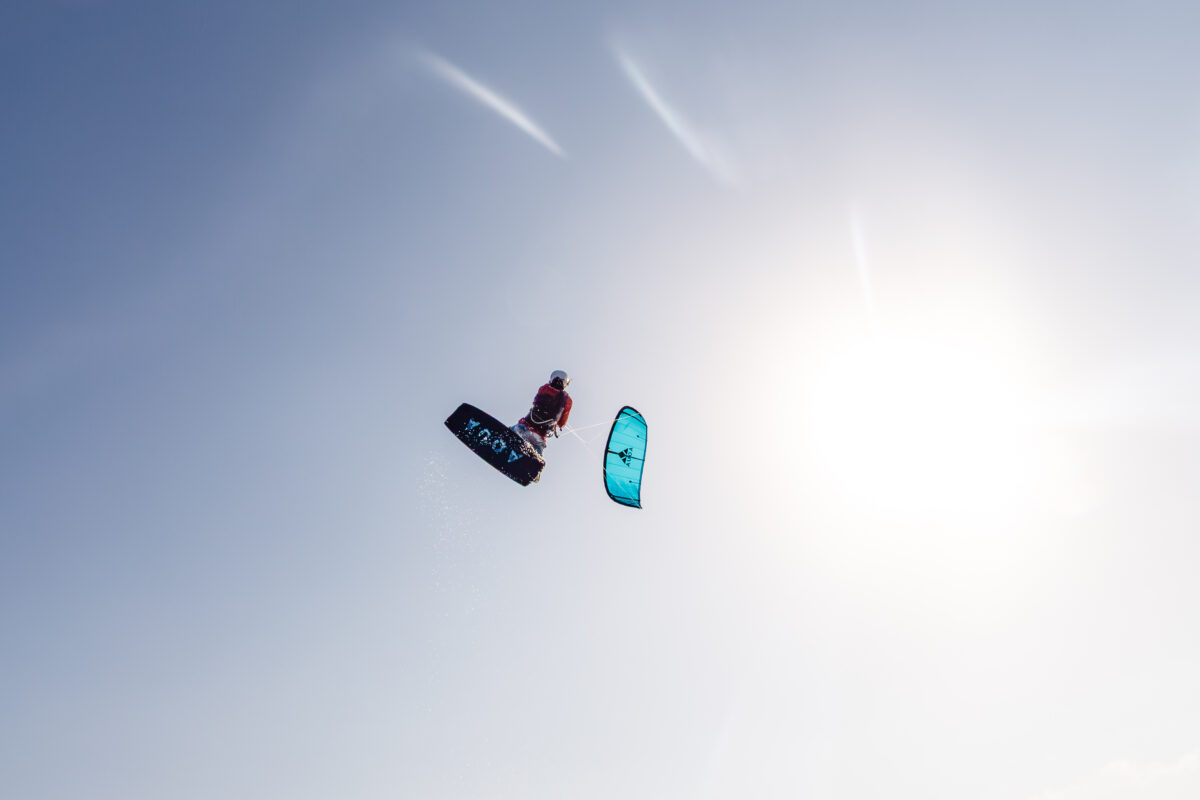
AOUA Kiteboarding have added a brand-new three-strut kite, the Rhei, to their range. Head of Product Development, Jan Alexander Rudolph gives us an overview.
What performance and flying characteristics does the Rhei exhibit?
The Rhei combines excellent loop performance with impressive jump height and hangtime. One of its key characteristics is how precisely the power can be controlled and how wide the power ratio is. You can steer the kite up very quickly for takeoff without losing your edge, but when you sheet in and release, the lift really kicks in much stronger than you’d expect. This puts a big smile on any kiter’s face, regardless of their level. The other main feature is the Rhei’s very fast and direct turning behavior, which is especially noticeable in kiteloops. The Rhei’s power can be retrieved and precisely adjusted even during aggressive steering in tricks and kiteloops. Even the bigger sizes feel surprisingly loopable and easy to trust. We calculated the centers of mass and moment together with the complex bridle system, so the kite benefits from stunning drift behavior. The low weight plays a role here. This makes line-slack during downwinders, wave riding and foiling very unlikely. And even if it occurs, the kite is very unlikely to invert.
How does its construction and materials choice contribute to these flying characteristics?
The Rhei’s performance comes from the combination of a very slim leading edge and strut frame, a carefully tuned no-pulley bridle, and a low overall weight. The reduced tube diameters make the kite lighter and faster through the air, while the stiff three-strut frame made from premium Japanese Teijin Dacron keeps the structure stable. Instead of making the kite light by simply choosing the lightest possible materials, we focused on saving weight through design. That is why we consciously use the more durable premium Japanese Teijin Dacron version, which is not the lightest option, but offers lower stretch and significantly higher durability. Still, due to the design, the kite has a weight comparable to expensive premium versions of other kite models on the market, where lighter but less durable materials are often used.
You discussed your seam technology in issue 62. Have you used the same for the Rhei?
Yes, our Digital Seam Reduction also plays an important role in the Rhei. It is based on our own software methodology, which allows us to unfold the complex three-dimensional kite surfaces into fewer cloth pieces, but without creating wrinkles. In addition, we avoid cutting the kite into unnecessary panels purely for the visual design – this way, we reduce seams by up to two-thirds while improving drag, precision, weight and durability.
And how did you achieve such a thin leading edge?
We were able to mathematically model the bending behavior of the leading edge and struts – here our background and experience in mechanical engineering was crucial. This model allowed us to define the tube diameters more precisely for each size. Every Rhei size was designed individually, so the larger sizes still have sufficient structural stiffness, but without unnecessary diameter and weight. The 6m, in contrast, has a relatively thicker leading edge, so it stays fun and does not become too twitchy. The finely tuned no-pulley bridle adds stability and allows us to use such a thin frame with confidence.
Tell us more about the bridle system.
We chose a finely tuned no-pulley bridle, with as many as seven attachment points per side. This supports the slim leading edge and gives the kite the stability it needs, while keeping the bar feedback very direct. The carefully chosen connection points on the leading edge and the bridle lengths enable the impressive turning behavior and very direct feel – you always know where your kite is, even when you don’t see it. For the bridle lines we use finest spliced 1.3mm German LIROS SK99 lines. They are extremely high quality, stronger than many 2mm lines, offer very low stretch, and create minimal aerodynamic drag. For this application, it is hard to go more premium than that. When riding, you’ll feel the minimized drag straight away in how close the kite can fly to the edge of the wind window, allowing you to go upwind at steeper angles.
Where have you been testing and riding the Rhei?
We tested and developed the Rhei for more than a year in the widest range of conditions – from steady winds to terrible gusty days – because the kite also has to deliver when conditions are far from perfect. During development, we needed to compare different designs and setups directly against each other. This, along with the final fine-tuning, was done mainly in Colombia. There we have months of consistent strong wind, which is exactly what we need for precise testing. It allows us to make small setup changes and immediately feel the difference under repeatable conditions. This is how we reach the level of refinement we need to make sure our clients enjoy their best days on the water. Furthermore in Colombia we find perfect conditions for durability tests. By choosing some of the most durable quality materials on the market, a Rhei kite can still look almost new after a full season in daily 20+ knot winds and some of the highest UV radiation on the planet. ■

You can get the latest goodness from the world of kiteboarding by subscribing to our print edition. You'll get 5 packed issues, plus a free tee and free digital access. And you'll be directly helping with our sustainability efforts too!
Check it out now